

 CN
CN
 EN
EN

About Us
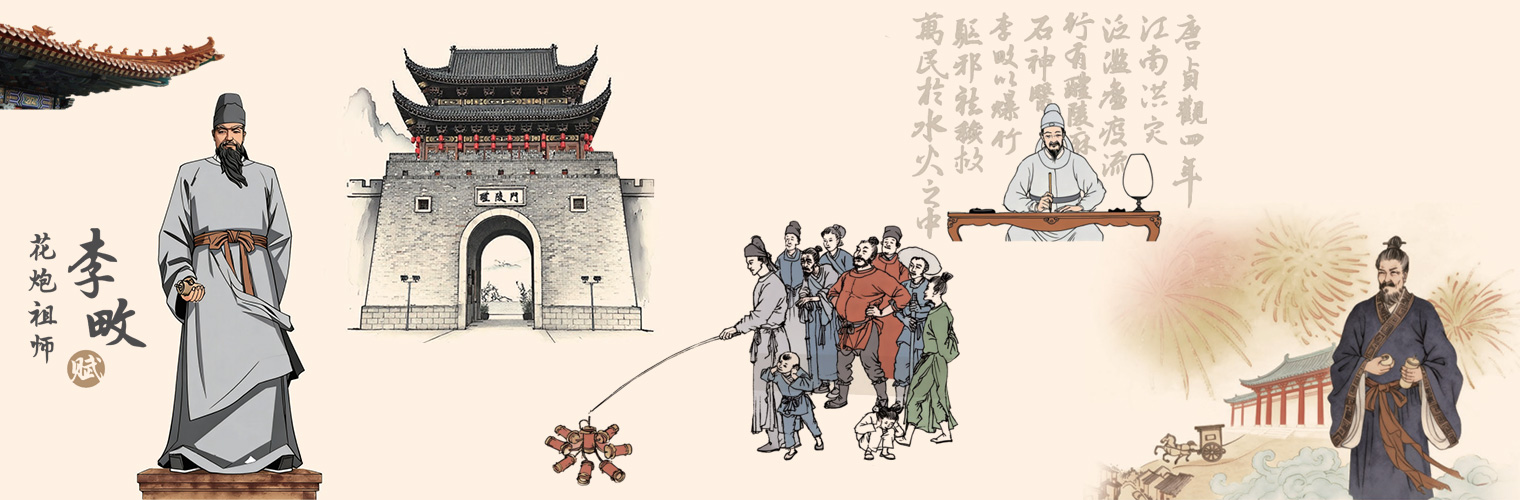
Ode to Li Tian, the Founder of Fireworks
Preface
By the banks of the Lushui River lies the ancient town of Liling. For over a thousand years, its fireworks have illuminated the world. Tracing the origin, we find Li Tian of the Tang Dynasty, who with masterful craftsmanship set the sky ablaze and broke the long night, thus being revered as the founding father of fireworks. Once I visited the Li Tian Temple in Fuli, where incense smoke curled around ancient steles. I imagined him in those days pounding herbs and mixing saltpeter — it felt as if the Milky Way had fallen to earth, with trees of fire and silver flowers. Now I compose this ode to praise his virtue and commemorate his achievements.
I. A Prodigy Born of the Age
Li Tian, courtesy name Zhongneng, was born in the final years of the Zhenguan era of the Tang Dynasty. His family practiced medicine for generations and possessed the secret manual The Classic of Herbs. As a child, Li was exceptionally intelligent. Observing the explosive burning of various plants, he suddenly grasped the principle of creation and transformation. Upon reaching adulthood, he abandoned medicine to devote himself to the study of pyrotechnics. In a secluded valley at Mashi, Liling, he cleared nine acres of wasteland and planted sulfur, saltpeter, and charcoal. By day he researched compounding techniques; by night he observed the movement of the stars — and eventually penetrated the way of balancing yin and yang.
II. Mastery Forged by Devotion
One day, Li loaded gunpowder into a bamboo tube, sealed it with clay to form a fuse, and struck it with a stone. In an instant, fire burst toward the heavens, and the sound shook the nine skies. Onlookers were astounded, calling it “heavenly fire,” and the townsfolk proclaimed that “Immortal Li has manifested.” Yet Li did not boast of himself. He continued to study for three more years and created such varieties as “Seven-Colored Thunder Pearls” and “Nine-Fold Brocade.” The craftsmanship was exquisite: sulfur had to be taken from the Chenzhou mines, saltpeter from the bed of the Lushui River, paper tubes made from bamboo joints, and fuses from ramie fiber — unquenchable by wind and undampened by moisture. From then on, Liling fireworks became famous throughout the land, merchants gathered in droves, and “ushering in the new year amidst the crackle of firecrackers” became a cherished tradition across China.
III. Virtue That Blesses the People
Although renowned for his pyrotechnics, Li Tian was compassionate at heart. Hearing that a mountain demon was terrorizing villagers in western Hunan, he created the “Demon-Suppressing Red Candle”: cinnabar talismans painted on the candle body that, when lit, could drive away evil spirits. He also made “Peace Firecrackers” — set off on New Year’s Eve, their sound was as clear as a chime and their light as gentle as the moon — calling them “Blossoms of Peace.” The grateful people built temples to honor him. Emperor Huizong of the Song Dynasty conferred upon him the title “Founding Master of Firecrackers,” and during the Qing Dynasty, Emperor Kangxi posthumously honored him as “Lingyou Zhenren” (True Man of Divine Blessing). His incense has thrived ever since.
IV. The Legacy of Intangible Cultural Heritage
As time flows on, Liling fireworks have been renewed while preserving their ancient essence. Contemporary craftsmen carry forward traditional methods and innovate in techniques. The ancestral ritual remains: every year on the 24th day of the 12th lunar month, artisans from all directions gather before the temple, burning three sacrificial animals, offering fine wine, and reciting “The Precepts of Master Li.” Young apprentices enter the temple to pay homage, kneeling as they vow, “Better to lose a thousand pieces of gold than to reveal a secret formula.” Amidst this blaze of fireworks, what is transmitted is not merely a craft, but the continuing pulse of a cultural heritage.
Postscript
I once heard an elderly craftsman in Liling say, “Making fireworks is like living a life: the gunpowder must be properly proportioned, and one’s path must be rightly walked.” These words are worthy of being inscribed on the temple walls. May future generations inherit Li Tian’s wisdom and uphold his integrity, so that the flower of Chinese civilization may forever blossom brilliantly on the world stage.
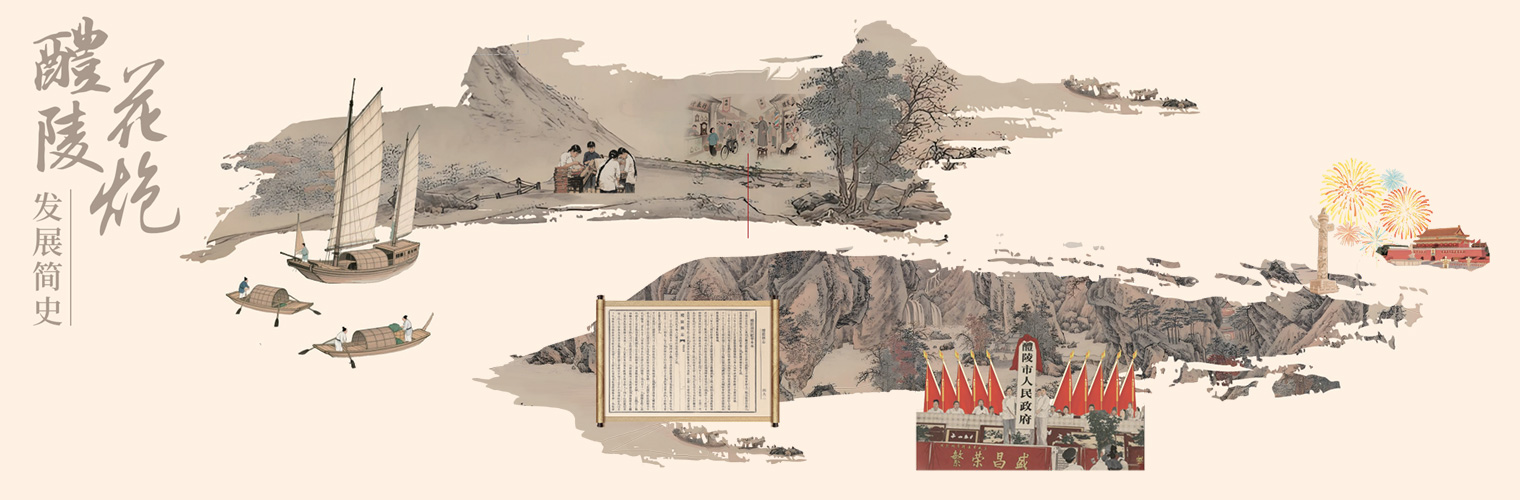
A Brief History of Liling Fireworks
In the 30th year of the Guangxu era of the Qing Dynasty (1904), Changsha was opened as a commercial port. Most Liling firecrackers were sold to other provinces through Liuyang merchants. As a result, “people outside only knew the name of Liuyang firecrackers, but were unaware of Liling firecrackers” (according to The Gazetteer of Liling County, Republican-era edition, Volume 6). Firecracker production in Liling was concentrated in Pukou and Baitu Lake areas. As recorded in the Industry and Commerce chapter of the Republican-era Gazetteer of Liling County: “In the spring of 1921, a severe famine struck the county. People from many villages fled to other regions for food. Only in the Eastern Third District (including Pukou and Baitu Lake) did no one suffer from starvation, thanks to the firecracker industry.”
After 1930, Liling’s firecracker output declined and exports dropped sharply. In 1936, with the completion of the Yue-Han Railway, the Zhe-Gan Railway, and the highways connecting Cha, You, and Liling, firecracker production and trade revived, and exports grew. At that time, in Baitu Lake alone, there were many merchants engaged in exporting firecrackers, such as Yongqingmei, Defenghou, Xinyuan, Yuanjiben, Jinxingqing, and Yuanjihui.
In 1932, He Jiming, a native of Liuyang, came to Liling and opened the “He Fasheng” workshop on Ximen (West Gate), becoming the first to produce fireworks. He created more than 20 varieties of fireworks. (From then on, firecrackers and fireworks were collectively referred to as huapao — fireworks and firecrackers.) During the War of Resistance Against Japan (1937–1945), production of fireworks and firecrackers largely ceased, and exports were interrupted. After the war, the industry gradually recovered.
In the early days after the founding of the People’s Republic of China (1949), fireworks and firecrackers were regarded as feudal superstitions, and production was restricted. Most workshops shut down. In 1953, the reputation of fireworks and firecrackers was restored, and they were recognized as festive and recreational products. The Liling People’s Government adopted policies to support their production. In 1956, more than 500 workshops across Liling’s urban and rural areas were consolidated into 77 firework and firecracker production factories (or groups), which were placed under unified arrangement by agricultural cooperatives. In 1963, the Liling County Committee of the Communist Party of China and the Liling County People’s Committee (County Government) proposed vigorously developing firecracker production and established a Firecracker Production Office.
To reverse the damage to Liling’s reputation caused by inferior products, the authorities reorganized the fireworks and firecracker manufacturing enterprises, eliminated individual workshops, and thereby improved the quality of Liling fireworks and restored their name. After the Third Plenary Session of the 11th Central Committee of the Communist Party of China (1978), township enterprises producing Liling fireworks flourished. In 1986, the output value of Liling fireworks reached 177 million yuan, surpassing Liuyang for the first time by 8%, ranking second in the nation.
Liling fireworks were used in more than 40 celebratory gala fireworks displays, including the Kunming World Expo, the 50th anniversary celebration of the founding of the People’s Republic of China in Beijing, the Macau Handover Celebration, the Qinhuangdao People’s Joyful Lantern Festival, and the Yunnan Pu’er Tea Festival. As a result, their visibility was greatly enhanced.